“Trying to piece together this story is a fool’s game. I wish I’d never started it.” Arliden.
The Kingkiller Chronicle is my favourite fantasy saga. I first read it in 2016 and the thousands of questions the plot raised were left unanswered since then. The first book opens on a dedication:
“And to my father, who taught me that if I was going to do something, I should take my time and do it right.”
A piece of wise advice considering the complexity of the plot. The last book came out in 2011, and Patrick Rothfuss will not release The Doors of Stone unless perfect.
I could no longer bear the wait for answers and decided to compile my own theories and the speculations made by readers online, with the goal of untangling the plot.
The most frustrating part about loving this story is being deeply aware that everything from the characters to the folklore is connected and intertwined. Worse, I highly suspect that the stories told through legends, folklore, songs, poems, or religion in order to help us understand the plot… are false!
In my head, the story is like a map with words and names: there is Kvothe, Denna, Auri, Elodin, the Maer, the Chandrian, the Amyr, the Adem, the Lackless family, the art of Naming, the Lethani, the Doors of Stone, the Fae, the Moon, the Creation War, the current war, the Cthaeh, Kvothe’s sword, Maedre, the Broken Tree, Jax, Iax, Haliax, Lanre, the Underthing, Encanis, Tehlu, Lanre, Lyra, Sir Savien, Aloine, Bredon, Count Threpe, and countless songs and poems. If I can trace some links between them, I still cannot fully grasp the story, and that’s why Patrick Rothfuss is a great world builder.
The following essay is structured to go through topics one by one, assuming that you are already familiar with the story and some of the most popular theories. I use my own theories alongside speculations made by readers online. I will not quote sources as theories are usually shared by different readers.
History of the World
The story is obviously bigger than Kvothe’s vendetta. Thousands of years ago, there was a world before the men and the Fae. Those who walked that world were called the Knowers and knew the deep name of things without having mastery or control over their nature. Then came the Shapers who wanted to control and shape things. It was beautiful until they grew hungry for power and shaped unnatural things. The Shapers were banned and created what is now the Fae Realm. At that point, there were two worlds, two skies and the Moon in the mortal sky.
One Shaper was more powerful and stole the Moon by catching a piece of her name. The Moon ended up forced between the two worlds, and when she is in the Fae Realm, it attracts the Fae to the human world through portals (Greystones/Waystones). Assuming this Shaper was Iax/Jax, Felurian informs us that he is set behind the Doors of Stone. The theft of the Moon started the Creation War between Shapers and Knowers, and horrible creatures created by the Shapers started slipping to the Knower’s world.
That story is told by Felurian but we learn more about the Creation War through Skarpi’s story. 8 cities were resisting the Creation War in the Ergen Empire: Belen, Antus, Vaeret, Tinusa, Emlen, Murilla, Murella and Myr Tariniel. Myr Tariniel was protected by the most powerful Namer, Selitos, who could read the heart of all men. Being in the mountains and protected by Selitos’s sight, Myr Tariniel was the only city unscarred by centuries of war. Other cities put their faith in others like the brave Lanre and his wife Lyra who knew the name of things.
At the Battle of Drossen Tor, the Knowers fought and Lanre killed a great black beast covered in scales sending it behind the Doors of Stone. Lanre died but was brought back from behind the doors of death by Lyra who spoke his name. It is said the enemy (Shapers and their creatures? Or just Iax/Jax?) was set behind the Doors of Stone, yet the war continued for a while, until Lyra died, and Lanre became mad with grief.
If we ignore what killed Lyra, Lanre believes her death to be on his hands. Several scenarios could explain her passing: Lyra became ill or weak after using her power to bring back Lanre. Lyra became sick, or died, after which Lanre sought the power to heal her or bring her back to life, only to fall to the dark side. Lyra betrayed Lanre, or Lanre was manipulated to kill Lyra. When Lanre says “My wife is dead. Deceit and treachery brought me to it, but her death is on my hands.”, I struggle to identify if Lanre expresses deceit and treachery brought him to destroy Myr Tariniel, or Lyra’s death?
The destruction of Myr Tariniel was made possible by Lanre using the name of stone, air and Selitos’s own name to bind him, a power that could be matched only by Aleph, Lyra, Iax and Selitos himself. It’s safe to assume Lanre acquired such powers to heal or bring back Lyra, but how?
It is said the Rhinna flower grows around the Cthaeh and could heal illness caused by poisons. The name reminds of how the Adem calls the Chandrian (Rhinta) or what is written on the walls of the University (Rhinata). Some suggest the word could be associated with the concepts of Naming or Shaping. By looking for the flower, Lanre would have acquired the power to name or shape. The Cthaeh could have corrupted his heart to seek destruction. I also believe Iax would have been able to use Shaping to make Lanre powerful, in exchange for Lanre turning to his cause. I could push the theory further and say Iax and Lanre became one. However, everything seems to indicate Iax died at the Blac of Drossen Tor.
The influence of Star Wars is palpable in Rothfuss’s work, which led me to think Lanre was convinced by some agent of chaos (Palpatine/the Cthaeh) that the dark side’s powers would save Lyra in exchange for loyalty. In the same way Anakin betrayed Obi-Wan and the Jedi Order to save Padme, only to end up with Padme’s death on his hands and forced to become Vader, unable to die, Lanre became Haliax.
What happened to Lanre echoes a mistake Kvothe did as a child. Studying with Abenthy, he once bound the air to his lung. That catastrophic event led Ben to tell Kvothe about the story of Lanre, in the hope that it would enlighten him about the dangers of power and stupidity. He will later remind Kvothe to remember this story. If we know from Ben that Lanre did not sell his soul, we can assume he bound his name to his power.
Why can’t Haliax die? Selitos tells him he could kill him for an hour or a day, but he would return pulled like a magnet, and that his name burns with the power within him, leading me to think Haliax gained his power by becoming immortal, and his immortality is tied to his name.
Lanre becomes Haliax and after destroying 6 cities heads to destroy Myr Tariniel where he and his followers are cursed by Selitos: “Your own name will be turned against you and you shall have no peace”; “and all that follows you”.
After the destruction of Myr Tariniel, Selitos asks Aleph for vengeance and creates the Amyr Order to hunt the Chandrian. The Ruach (another faction) agreed to stand with Selitos and became the Amyr. Others did not want to play any part and retreated in what we assume to now be the Adem and the Edemah Ruh. One could imagine that the Edemah Ruh troupes who sung about the Chandrian were killed, but the Adem who do not take part in art preserved the story through careful transmission.
Aside from the original Amyr, the Church created a more bureaucratic Order made up of human knights. Sir Savien Traliard was one of them and Kvothe’s favourite; another was Atreyon. They were disbanded 300 years ago, but probably just went into hiding. They made some terrible things towards the end. Their mantra was “Ivare Enim Euge”, translated as “for the Greater Good” and the Count of Gibea was one of them.
After the creation of the Amyr, Tehlu, decided to leave this world to serve Aleph better. Eight volunteers came forward to become Tehlu’s Angels:
Tall Kirel, who had been burned in Myr Tariniel
Deah, who had lost two husbands and had a cold heart
Enlas, who did not eat animals and carried no sword
Fair Gesa, who had many suitors before Belen fell, and was raped
Lecelte, who laughed easily
Imet, who didn’t sing and killed easily
Ordal, a young girl who had never seen anything die
Andan, whose name meant anger
It is said of Tehlu and his Angels that only the most powerful can see them, and only in great peril. They bear “wings of fire and shadow. Wings of iron and glass. Wings of stone and blood.”. They can see the heart of men and are wise and righteous.
After hearing about the Creation War and the Chandrian from Felurian and Skarpi, we hear it last from the Adem.
Shehyn tells the story of the seven and one city. The empire had an enemy that wanted to see it fall but was not strong enough, so he moved “like a worm in a fruit”.
“[…] There were seven cities and one city. The names of the seven cities are forgotten, for they are fallen to treachery and destroyed by time. The one city was destroyed as well, but its name remains. It was called Tariniel.”
“The enemy was not of the Lethani. He poisoned seven others against the empire, and they forgot the Lethani. Six of them betrayed the cities that trusted them. Six cities fell and their names are forgotten.”
“One remembered the Lethani, and did not betray a city. That city did not fall. One of them remembered the Lethani, and the empire was left with hope. But even the name of that city is forgotten, buried in time.”
“But seven names are remembered. The name of the one and of the six who follow him.”
The wording of that story is so tricky, it’s almost a riddle.
Here’s why:
- The eight remaining cities had their own protector, but we know Lanre was not the appointed protector of any specific city. Therefore, should we consider eight protectors excluding Lanre? We know six of these protectors betrayed these cities. That makes Haliax as the enemy, six Chandrian betraying cities, one city not betrayed by their protector and not destroyed, and Selitos not betraying Myr Tariniel, but the city being destroyed.
- Is the enemy Haliax? If not, then the heart of Haliax and six others were poisoned. If yes, then should we consider Selitos as one of those who also forgot the Lethani by cursing Lanre’s name?
- It’s confirmed everywhere that the Chandrian are seven, but although it could be an editing mistake, it is once said “Haliax and the Seven”. Why are there eight angels but seven Chandrian?
My interpretation is that Haliax poisoned the heart of six protectors. The seven who forgot the Lethani are the six who follow Haliax and Selitos for cursing Lanre’s name. I believe the city who did not fall to treachery was Tinusa as it’s probably the current city of Tinuë, and the name would not have stuck had the city been destroyed. It’s also called the free city of Tinuë.
The Lethani is always difficult to explain, even by the Adem themselves, but could be described as doing the right thing. Knowers used to know the name of things but thought it was against the natural order of things to control them, unlike the Shapers. I always assumed the Lethani came from there. An enemy who was not of the Lethani could also have been the Cthaeh or Iax.
Another story is shared by Trapis about Tehlu and Encanis. In the story, demons were walking the lands, corrupting the heart of humans, but we know from Kvothe, Bast and Shehyn that demons do not actually exist. The general interpretation is that this story takes place during the Creation War and the demons were either Shapers and/or creatures that escaped from the Fae Realm. One of the demons was Encanis, swallowed in darkness (just like Haliax). Perial, a wise woman who understood people’s suffering, birthed Menda. He was the son of Tehlu and knew the heart of all men (just like Selitos). The son of Tehlu chased all the demons away, except Encanis who burned seven cities, until Tehlu captured him on a wheel in Atur and died while killing him.
As Kvothe’s mother says: “people in Vintas like their demons metaphorical”. Hence this story could merely be a metaphor for the Creation War. It is suggested that Haliax and the six who followed him refused Tehlu’s path. At the time the story is told, the path of Tehlu is the main accepted religion with an active Church, yet, we know from Skarpi’s story that Tehlu was not really a god but more of an entity that spread justice with his angels, himself bowing to Aleph. It’s then interesting to think that the Tehlu Church bans anything related to the University. After hearing that story, Kvothe suspects Trapis to be a Tehlin priest.
What is the purpose of the Chandrian?
Haliax’s purpose was to destroy the world. Did his purpose remain the same after his name was cursed? There is no evidence that the Chandrian have any intentions of doing so, at least not on a large scale. Their purpose might have more to do with finding a way to die.
When Selitos offers to kill Haliax, we learn it cannot be done because his name burns with his power. Then, Selitos cursed the Seven’s names. Every time the Chandrian’s names are spoken, they feel pulled.
Three theories are favoured to justify the Chandrian’s agenda:
1. They are trying to erase every trace of their names and existence.
This echoes Mexican beliefs that the spirit of our loved ones lives as long as someone remembers them.
2. The Chandrian are researching a way to open the Doors of Stone, either to die or unleash chaos.
3. The Chandrian have been framed and are trying to rewrite their story.
We encounter them three times in the story. First, when they kill Kvothe’s troupe after his father sang their names. Secondly, at the Mauthen Farm red-wedding where, a jar representing them was found. Thirdly, when Kvothe finds bandits in the forest and Cinder is among them. It is said they are cold to the touch, fires don’t burn around them, and they can only move through Haliax’s shadow. The Amyr, the Sithe and the Singers are after them.
If Haliax used to be Lanre, there has been theories suggesting whether he could also be Iax and/or Jax, but that theory can be ruled out by Felurian distinguishing between the two while being a reliable source of information.
More is said about Lanre in Arliden’s first verse: “Hear how he fought, fell (Battle of Drossen Tor), and rose again (Lyra brought him back), to fall again (becoming Haliax), under the shadow falling then (Haliax’s shadow). Love felled him, love for native land, and love of his wife Lyra, at whose calling some says he rose through the doors of death (The Doors of Stone?).”
This story is central to understanding the plot, but doing so is impossible unless the real story is uncovered. Was Lanre actually betrayed and tricked? In the Song of Seven Sorrows written by Denna, Lanre is the hero. She sings that Lanre did what few men could bear and was betrayed. This argument is supported by the jar retrieved in the Mauthen Farm. The one-third of the jar Nina reproduced showed seven people, an Amyr, and a woman. Haliax was in the middle, covered in shadow. Above his head were three moons, and he held two candles: one with light, and one without. The six Chandrian were behind him, facing the Amyr. Nina explained how she felt joy when looking at the painting, but the Amyr gave her a horrible impression to look at. There was also a woman holding a broken sword in front of a tree. The woman could be Lyra or Perial. The tree could be the Cthaeh or the Adem Sword Tree.
Felurian, Shehyn and Skarpi are reliable sources and there is no reason to doubt them, but why would Nina have nightmares about Selitos? Why would Denna’s patron push her to write and spread a song about Lanre’s betrayal? After all, Haliax has a certain sense of justice as he asked Cinder not to be unnecessarily cruel, reminding him violence was not the purpose of the Chandrian. My guess is that the Chandrian are bad, but so was Selitos.
Cinder
“Just tell me when I hit one you like… Federick the Flippant. Frank. Feran. Forue. Fordale…”
The most accepted and widespread theory in the fandom is about Denna’s patron being the Chandrian Cinder, disguised as Bredon. On Nina’s jar, Cinder is described surrounded by ashes, as per his name. When Kvothe, our talented Namer, decides to assign a nickname to Denna’s mysterious patron, he picks Master Ash. However, as we learn through the Adem, Cinder’s real name is Ferula. When Kvothe makes another attempt at guessing the patron’s name, he randomly blurts out three names: one starting with the syllable FE, one with RU, and one with LE. In English, Ferule actually means beating and punishment, which echoes the Cthaeh telling Kvothe Denna’s patron beats her with his walking stick. It’s this confession that led many readers to guess that Bredon, who has a walking stick, was Cinder in disguise. Bredon shares to take dance lessons, and Denna describes her patron as graceful and a good dancer. He also disappears in the same period as Denna, and play Tak, a game so old only Felurian knows it, and is rumoured to engage in pagan rituals in the wood by people from the Court. After all, a song says that the Chandrian live amongst humans and are actually quite nice to us. The Cthaeh even pushes further saying Kvothe don’t even notice it when he comes for a drink. Which led me to wonder if Count Threpe could also be a Chandrian since he hunts for talented musicians, has a grey beard and says things like “I haven’t seen you in a mortal age.”.
Why is Cinder disguised as Bredon playing noble at the Maer’s court? And why is he leading a group of bandits to steal the Maer’s taxes? Bredon confesses that he used to love influencing politics when he was younger. We also know he helps Denna research genealogy to write the Song of Seven Sorrows. Denna guesses he wants to impress a noble, maybe the Maer? Someone who would have access to the Lacklesses’s door? Someone who, by marrying a Lackless, would have a Lackless heir? Because he likes playing long beautiful games of Tak where the strategy is revealed at the end, it’s possible Cinder has his own agenda against Haliax.
A third Chandrian is Scyphus, whose name is strikingly similar to the name of the wizard-king Cyphus, who captured Taborlin in a Tower.
The four other Chandrian are not yet relevant to the story, but two are described as bald men with a grey beard (Count Threpe? Skarpi?). Their main signs are: blue fire, bad air in mines, plants dying, wood rots, metal rust, brick crumbles, and animals going mad. If Bredon is Cinder, one can wonder whether other characters are hiding their true nature.
Are the Chandrian being framed?
Although I would never deny that the Chandrian are a cruel and destructive force, some details led me to wonder if they had been framed, as mentioned before through Nina’s jar and the Song of Seven Sorrows.
Did the Chandrian kill Kvothe’s parents? It’s heavily implied, but nothing confirms it. When Denna describes the event of the Mauthen’s wedding, she hides in the wood with her patron (Cinder) who orders her to stay hidden while he goes check. Was he maybe just going to pick up the jar? People at the Mauthen Farm wedding were not torn apart but rather slaughtered by swords.
In KKC, the good and bad are often intertwined. The Amyr, Selitos and Tehlu’s Church are noble elements that seem to have some dark background to them. The Chandrian or Encanis seem to not always have negative meaning associated with them. For example, a disguised Encanis who seems to be a metaphor for Haliax helps Kvothe in an alley of Tarbean, until he ran away because “someone might think he had done it”. Similarly, Kvothe is also associated to good and bad symbolism: Taborlin, a Ciridae, Caesura’s owner, but also allegedly being a Chandrian, a Kingkiller and Maedre.
The story makes it look like the Chandrian are trying to erase traces of their existence by killing anyone who knows about them, but are also trying to spread a truth.
We know Lanre spoke with the Cthaeh before becoming Haliax, and that the Sithe hunt anyone who’s been in touch with the Cthaeh, or anyone who has spoken to it. What if the Sithe are the ones who killed Kvothe’s troupe and people at the Mauthen’s wedding?
Additionally, Andrew Petersen on Quora smartly points out that vengeance is the business of men, and the Chandrian are not humans.
Upon him I will visit famine and a fire,
Till all around him desolation rings
And all the demons in the outer dark
Look on amazed and recognize
That vengeance is the business of a man
Another poem points to the Chandrian being friendly:
The Chandrian move from place to place,
But they never leave a trace.
They hold their secrets very tight,
But they never scratch and they never bite.
They never fight and they never fuss.
In fact they are quite nice to us
They come and they go in the blink of an eye,
Like a bright bolt lightning out of the sky
I’ve suspected they move through Greystones or Waystones. Ruh stops there out of tradition, and the Chandrian were near Greystones twice. Do they travel through it? Kvothe’s father gives a rhythm: “Greystone leads to …” – it ends with [ell] but he cannot remember. Farewell? Hell? Hallowell? Tariniel? I’ve always found it funny that Arliden, an accomplished comedian who remembers hundreds of plays, songs and poems forgot that word. Just like the Adem forgot what moved them from their original place. It’s as if their memories were wiped. It could also be Faeriniel, a place where all roads meet but that cannot be found. It’s not a place one travels to, but somewhere one pass by while going somewhere else.
A final theory is about the Chandrian being a group of eight, based on the fact that there are eight cities, eight people on the jar and eight Angels. Some people argue that Fela would be the 8th Chandrian as Felling is the 8th day of the week, she knows the name of stone and works in the Archives. Some think it was not an accident she caused the fire that led to Denna encountering Master Ash. It could be an editing mistake, but Skarpi also talks about Haliax and the Seven in his story.
Kvothe
Kvothe is a deeply complex character in the sense that he is charming and kind, but there is an unsettling darkness to him that many around him notices. He reminds at the same time of a Chandrian, Taborlin the Great and especially an Amyr.
Many details point towards Kvothe being one or like one of the Ciridae. Auri compares him to one, he has a strong sense of justice, his relationship with Denna reminds of Sir Savien Traliard and Aloine, and he chases the Chandrian.
There is this one scene where Kvothe and Simmon are studying the Amyr in the library and Kvothe do something extremely Amyr-like, which could be a sign/parallel to what happened to them. As they were studying in the library, some students were being loud, and Kvothe abruptly tells them to shut up. Master Lorren then comes, and punishes Kvothe for speaking too loud, although he was merely trying to bring the silence back. Simmon proceeds to say how Kvothe always do the right thing, even if not in the best way, and Kvothe says he hopes someone will tell Master Lorren the misunderstanding, that he was doing justice and not disturbance. What if the Amyr were trying to do the right thing and got into trouble because of someone else’s lie, and hoped someone will tell the truth about them? What if Haliax/the Chandrian were trying to do the right thing before being cursed by Selitos and are hoping someone will tell the truth about them, hence Cinder sponsoring Denna’s song?
If Kvothe is not an Amyr, he is very much like the reincarnation of Taborlin, bringing thunder, having a Shaed, owning a key, a coin and a candle, all gifted by Auri. In the forest, after chasing the bandits, Kvothe tries to open a chest as someone jokes he is like Taborlin. He screams “Wedro!” as a joke, but the chest opens and Kvothe has to act like he is not surprised to not worry the people – but how? If many details point towards the resemblance of Kvothe and Taborlin, we must also mention the fact that Maedre means thunder. Taborlin was a Namer and knew the name of the wind, which inspired Kvothe to go to the University. In the tale, Taborlin is captured by the Chandrian and locked in a high tower with no doors, but he uses his powers to escape, like Kvothe in Elodin’s tower.
On the other hand, it seems Kvothe became something close to a Chandrian. It is Chronicler who points out:“Some people say there is a new Chandrian, with hair as red as the blood he spills” and Kvothe says “The important people know the difference”. He does not sleep, seems unable to die, and probably cursed his name and his power when he promised Denna he wouldn’t look after her patron. While at the inn, a creature comes and asks Kvothe/Kote “Te Rinthae”, which could mean “You’re a Chandrian/Nameless?”.
Kvothe has a dark side. Vashet says he can bend the world with his words (more Shaper than Knower then?). She admitted liking Kvothe because there was a gentleness to him, but she also saw flickers of something else she tried to ignore: a mask, and a ruthless, dark, troubling unease within him. Chronicler himself said he “looks like he killed an Angel”, and that some people say Kvothe had gone looking for his heart’s desire, had to trick a demon to get it but once it rested in his hand, he was forced to fight an angel to keep it.
One thing we know about the story is that Naming is considered noble, and Shaping is considered controlling. Again, it reminds me of Star Wars with the Jedi and the Sith, which depends on what the Force is used for. Kvothe is very good at Knowing and Naming (his name actually means to know), but could Vashet sense his desire for greater purposes? His Adem name is Maedre which can mean the Flame, the Thunder or Broken Tree. Kvothe explains that flame relates to his hair, and thunder to his baritone. I’d assume it relates more to him calling the thunder several times. He also says that Broken Tree is not very significant, yet slightly prophetic, hence I’d assume he manages to destroy the Cthaeh, or the precious Adem Sword Tree. One of the reasons I think it could be the Cthaeh is that he would not share having talked to the Cthaeh if the Sithe were after him.
Kvothe was warned by Ben as a child to remember Lanre’s story about power and stupidity, which happened after Kvothe bound the air to his lungs. Kvothe is charming but always deceives people: he enters the Archives without Master Lorren knowing, he builds a gram even though he’s not allowed and frequently uses Malfeasance. A few days after learning about the Lethani, Kvothe already kills a troupe who had kidnapped girls, and goes as far as to torturing one man. He’s always in the grey, doing dark things for noble reasons. Many details in Kvothe echo heroes (Sir Savien, Taborlin, Amyr) but also villains (Chandrian, Lanre).
Kvothe, Bast, Chronicler and the Civil War
The events that led Kvothe to hide under a new identity at the Waystone Inn are unclear. The creatures similar to the ones reported during the Creation War led us to believe he managed to open the Doors, and/or released the Moon’s name. He could also have released King Feyda who is alledgedly set behind the Doors (see later).
Kvothe started a civil war, probably by killing a king. The king could be the Maer, Ambrose or King Feyda. Some people suggest it could the King of Vint, Roderic of the House Calenthis, because of the parallel of Kvothe killing the little calenthis birds in the Maer’s room. Kvothe’s sword being called Caesura could mean the end of the Calenthis line. We know the new king is nicknamed the “Penitent King” which relates to repenting about a mistake. Maybe the Maer ordered Kvothe to kill him to become King of Vint, as he should have been. We also know that some rebels are opposing him.
He’s also lost his powers which we can assume happened by cursing himself when he promised Denna not to look into her patron. Someone online suggested that his name is locked in the thrice- locked chest, and he cannot open it, having also cursed his power. They added that it’s like his car keys are inside the car. We know Kvothe made the chest himself, it’s made of roah, sealed three times with a lock of iron, a lock of copper and a lock no one can see, and smells of citrus and quenching iron. Kvothe feels longing and regret looking at it.
The present takes place two years after the events that led Kvothe to hide, but he’s only been at the Inn for a year. The Inn is somewhere west, potentially around Vintas since Selas flowers grow behind it.
Where did Kvothe meet Bast and why is he teaching him? My guess is that Kvothe spent some more time in the Fae after he promised Felurian he would return, which is supported by him looking older. On the other hand, Bast might have been part of Kvothe’s life before the catastrophic events as we know that he has met Denna. The way Kvothe interacts with Bast clashes with the young version of Kvothe we get to meet in the story. Bast is a 150-year-old Fae but Kvothe is the one mentoring him. Why would a powerful Fae want to learn from Kvothe?
As for Chronicler, his real name is Devon Lochees, probably a descendant of the Lackless family. He was on his way to meet Skarpi in Treya when his direction was changed at Bast’s request. I suspect Bast was observing Chronicler in the form of a crow. Since Skarpi is a colleague of Chronicler, we could assume they are both skrives working for the Archives. But was Skarpi’s story reliable? Kvothe calls both Chronicler and Skarpi rumourmongers.
What else? He wears many rings. There is a poem about Kvothe wearing rings of stone, iron, amber, wood and bone, rings unseen on his other hand. One was blood in a flowing band, one of air all whisper thin, and the ring of ice had a flaw within. The ring of flame, and the final ring was without name. Some of the rings can be traced back to his time in the Maer’s court. The ring of wood could be from Auri or Meluan, as they both gave him one. The rings of air, stone and amber could be elements he had mastered.
Kvothe’s origins
Kvothe’s origins are questionable due to his red hair and lack of resemblance to his parents. He once meets a man, Viari, in the Archives who thinks he is Yllish. Some people suggest the Edemah Ruh could descend from Yllish ancestors, which would be why their most famous singer is Illien. This could also explain why, if the Edemah Ruh and the Adem are indeed from similar ancestors, they were displaced from their original land.
Kvothe has also always been slightly Fae, even before his time with Felurian. He heals very quickly, and Deoch points out he looks a little Fae around the edges. My theory is that Kvothe develops Fae characteristics when he was lost in the forest as a child, after his troupe was killed. We know one might develop Fae characteristics when spending time in the Realm, drinking the water and eating food that grows there. The reason I believe he was actually hiding in the Fae Realm all that time was because he would sleep beneath a Greystone, which are known to be portals. He jokes that had he been born a couple of years ago, he would have been burned for his hair because it sticks up and it makes him look like a demon, and he once woke up on a wheel like Encanis.
Denna
“Names are important as they tell you a great deal about a person.”
From the most to least likely, I have three theories about Denna:
Denna is Kvothe’s mirror
Denna is one of Tehlu’s Angels or an Amyr
Denna is the reincarnation of Aloine or Lyra
What do we know about Denna? Denna is not her real name but the name she was using when she met Kvothe in Tarbean. After their encounter, she frequently changes name: Dianne, Dinae, Dinnah, Dinay. She gets called randomly Alora once, which is quite different from the D-names she usually uses and makes me think of Aloine.
The name Denna reminds of the Denner drug. Kvothe is so addicted to Denna that he does dangerous things for her. I’d love to ask Patrick Rothfuss if he named Denna after the drug or the drug after Denna. It’s also a Fae word used by Kvothe when he insults Bast as a joke: “Aroi te denna-leyan”.
Denna seems at first glance to be what people say she is: a young girl who ran away from home and court men for her financial security. It’s validated several times in the story by Deoch and Stanchion, when Kvothe eavesdrops on her, or from what Denna herself shares with Kvothe. Yet, a few things about Denna make her anything but common, notably, her knowledge of ancient things: she jokes about receiving a leaf from the Singing Tree, she knows Yllish knots while Kvothe himself is unable to learn the language, she casually kills a man in an alley, and usually appears out of nowhere. Denna doesn’t seem to age much either as she’s assumed to be around 16 when Kvothe meets her, but Deoch already knew her for two years and says she doesn’t seem to look older. It would be weird is 14 years old Denna wandered around the Kingdom courting men.
For a long time, I pondered about Denna. Is she just a normal girl? Is she the Moon? An Angel? She seemed to have an ancient knowledge of things, while at the same time not knowing about soul contracts or that her patron is a Chandrian. I found my answer by asking myself what Denna knows of Kvothe?
Denna sees Kvothe as a young University student who is rather poor. She knows he is smart and charming. As a reader, we tend to forget that Denna does not know Kvothe is powerful, that he can call the wind, fight like an Adem, call thunder or kill 27 men with blood magic. She doesn’t know he survived two years in the streets of Tarbean, saw his troupe being killed and lived in debt at the University. She does not even know Ambrose is Kvothe’s enemy.
This led me to a perspective: Denna is Kvothe’s mirror. Like an Edemah Ruh, she moves from place to place and cannot set roots anywhere (“has wandering blood”). Like Kvothe, she acts charming and innocent but can actually kill a man. Like Kvothe, she is lonely in the world, constantly fighting for financial survival, looking for a patron. She has knowledge of ancient things, knows songs and plays the common people do not know. Like Kvothe with herself, she cannot find him when she wants and states she looks for him everywhere. Her ability to read signs on moneylenders’ place indicate she might have had a rough childhood as well.
Their path is similar and they are two sides of the same coin. For those reasons, I sometimes see Denna and Kvothe as Aloine and Sir Savien Traliard reincarnated, and sometimes as Lanre and Lyra. The love story sung in the Lay of Sir Savien Traliard resembles that of Kvothe and Denna as Kvothe is constantly desperate to be with her, but every time he seeks her, she’s nowhere to be found. Denna says the same thing about Kvothe, yet they always find each other randomly when they least expect it in Trebon, Tarbean, Severen or Imre. They’re like star-crossed lovers that search for each other in every lifetime. Denna uses the name of Alora once, which resembles Aloine.
“Well, I’m glad you made it back, my Aloine”.
When Denna was a baby, she died and came back to life. We also know she suffers from lung issues and often have nightmares. I have yet to figure out what to do with that information, but I sometimes imagine Lanre would have revived Lyra in another lifetime under Denna. There are some similarities between Lanre and Kvothe too, as they both spoke to the Cthaeh, are both good people slightly attracted to the dark side and are both… Chandrian, Nameless and Sleepless. Kvothe did bring back Denna to life when he found her breathless in a bar by calling her name. I could also see Lanre or Lyra being a Lackless, which would explain why Meluan reminded Kvothe of Denna (although it is heavily implied that Meluan is Kvothe’s aunt). After all, Lyra means harp, an instrument very present in Denna’s development.
Another theory I have is that Denna is one of Tehlu’s Angels, or one of the original Amyr. Out of the eight Angels, two were women. The first one was Deah, a name fairly similar to the names Denna borrows. The other one was Fair Gesa, who had been raped and was from Belen. Disdain for men is one of Denna’s key characteristics, and we once found her in an alley rescuing a young girl victim of sexual abuse. Kvothe also describes Denna as “wise and terrible”, two words used to describe Tehlu’s Angels. Chronicler heard that Kvothe went after his heart’s desire and once he found it, he had to fight an angel to keep it, which led me to wonder if it could be Denna, his heart’s desire being finding the Chandrian.
When Kvothe met Denna on the road, he catches her interest with seven words that seem so important to Denna she claimed she fell in love: “I was wondering what you are doing here”. If the immortal Amyr, after becoming unpopular by the misdeeds of the false Amyr Church Order (just a theory), went into hiding, could Denna have been moved by Kvothe noticing her, when she was wandering and purposeless? As an Amyr, she could also be hunting the Chandrian, who always run away when they feel the Amyr or the Sithe close by.
“What happened in Anilin” “Nothing pleasant, but nothing unexpected” Could refer to another man upsetting Denna like always, or to the Chandrian running away once more. This quote also echoes the two men trying to kill Kvothe near the University, saying they don’t want another mess like in Anilin, a place Denna had recently been at.
In the second book, there is one very innocent remark Kvothe makes, which I adore since Patrick Rothfuss’ breadcrumbing is what keeps us alert. Kvothe finally runs into Denna in a park, and she is eating a pear when it’s not the season: “Where has she come by a pear so late in the season?”. It has always made me think that Patrick wants us to notice that Denna travels a lot, but she travels fast, as if she had wings. We even hear Kvothe say once to Deoch that he will make Denna “come back in a winged flight”.
The other main story that makes me think Denna is an Amyr or an Angel (and especially Fair Gesa or Deah) is what happens when Kvothe follows Denna into an alley. He catches her rescuing a girl whom we may think has been sexually abused. Denna kills the man with a knife/sword he describes as moonlight glitter, and Kvothe describes it as almost casually. This whole chapter shows that Denna is not afraid to kill and that it might not be the first time she has done so. The conversation she has in the bar after killing the man shows once more her disdain for men. She talks a lot about courting men for financial purposes, and regrets how the crying girl is like looking in a mirror. We could think then that Denna is just a simple girl who ran away and ended up courting men for survival, but it could also be the experience of the Angel Fair Gesa who had been raped too.
Denna also reminds me of the Moon. She resents men who want to possess her without respecting what she is, just like Jax wanted to possess the Moon, disregarding the fact that the Moon just is, and cannot be owned. Denna wears a pale blue ring, which has always reminded me of a Moonstone. I’ll add that Denna was in the Maer’s garden on a night with no Moon and the time Kvothe followed her in an alley, he saw something he described as moonlight glitter. Her voice also reminds Kvothe of cool moonlight.
I sometimes favour the theory that Denna is just Denna. If she were an Amyr, Angel, Chandrian, or Aloine, why would she be so young? Why would she be surprised that Kvothe mentions the Chandrian? Why can’t she defend herself against her patron if she can kill a man in an alley? Why does she ask about sympathy? Kvothe always describes her as a force to be reckoned with, but we know that Kvothe tends to exaggerate stories. For example, he did not really set Tarbean on fire; he was indirectly linked to it. And as Bast mentioned, he’s seen Denna and pointed out that her beauty was not as breathtaking as Kvothe described it to be. Anyhow, the story is heavily linked to Denna because when Kvothe starts telling his story to Chronicler, he says it all began when he heard her sing.
Finally, we can assume Denna is under some form of blood contract after she became pale upon hearing from Simmon or Willem to never give a drop of her blood. She asks about sympathy and magic, and if things can come true if written down, even if the person who signed it wouldn’t be able to read it. Hence, Denna put herself in trouble.
The Cthaeh
The Cthaeh is a malevolent tree in the Fae land that knows and sees all possible futures to influence disastrous events. If one talks to the Cthaeh, all their actions are influenced and lead to catastrophic decisions, which is why the Sithe are charged with eliminating anyone who has talked to the tree. According to Bast, the Cthaeh talked to Lanre and started the Creation War.
The conversation between Kvothe and the Cthaeh is a riddle filled with easter eggs. First, he recommends Kvothe to call the Chandrian the Seven, because Chandrian is too closely linked to folklore, and says that Haliax has been alive for 5000 years. He says it’s clever to go looking for the Amyr, but they are as hard to find as them, implying they still exist. He also says that no one who knows about the Chandrian will talk about it, and that it is the price of civilization. This comment made me think of how the Adem, who obviously know about the Seven, consider themselves civilized for keeping silence whenever they can, and other cultures barbarians. The Cthaeh says there is no hope to hear about the Chandrian until one makes it to Stormwal, which is a location we’ve never heard of before, but rather close to Ademre on the map. He says the Maer came close to the Amyr once, but doesn’t realize it, and we know the Maer was studying them in his youth. The library the Maer was going through might be where Kvothe could find information.
The Cthaeh confirms the Chandrian had good reasons to kill Kvothe’s parents, but left him alive because they were sloppy, and something scared them away, probably Tehlu’s Angels, the Amyr or the Sithe.
The Cthaeh also refers to the Doors of Stone when he says “Stick by the Maer, and he will lead you to their door”, while joking he will understand the pun someday. Aside from mentioning the Doors, “Stick” could also refer to Bredon/Cinder being at the Maer’s court. We guess the Chandrian are trying to go behind or open the Doors, but they could need the seven elements mentioned in the Lackless poems, among other things, an heir. Bredon/Cinder could be plotting in the Court to gain the Maer’s trust, by, for example, composing the Song of Seven Sorrows or researching genealogy.
Finally, he provokes Kvothe by describing to him how Denna’s patron beat her with his walking stick, whom we assume to be Cinder/Bredon. The Cthaeh adds that it’s funny Kvothe doesn’t notice him when he comes to grab a drink and that Kvothe didn’t get wind of him (wind?).
The Cthaeh’s origins
Has the Cthaeh always existed in the Fae Realm, or was he a human-like character before? I have no serious theory about who the Cthaeh could be, but he could be mentioned symbolically in stories, as, for example, the Tinker who advised Jax on how to learn the Moon’s name, or Encanis: “Encanis roamed the world causing as much mayhem and destruction as he could” and had “a voice like a knife in the minds of men”. Encanis who could also be a metaphor for Selitos.
The symbolism of trees is heavily repeated throughout the story: the Cthaeh, the Adem Sword Tree, Kvothe being called Maedre, which means Broken Tree, the dead tree behind the Chandrian on Nina’s jar, and the living and dead tree on King Feyda’s coin (see later). My theory is that Lanre or one of the Chandrian was from an Adem school path, and the concept of “Broken Tree” means forgetting the Lethani. This would explain why Vashet is upset about Kvothe’s Adem name, but why owning Caesura as a sword offsets his name. Maedre would have been someone in the past who forgot the Lethani, but a previous owner of Caesura would have done noble things. We know from Caesura’s Atas that one of its owners killed enemies at the Blac of Drossen Tor.
The origins of the Sithe support the links between the Cthaeh and the Adem. Also called the White Riders, they ride into battle with long horn bows, an art taught by Rethe and Aethe’s school. They are a faction of the Fae court, wear crowns woven of holly bough, silver armor and robes.
Their purpose is to make sure no one interacts with the Cthaeh and kill anyone who had heard a prophecy from it. I’ve always wondered: How did the Sithe let Kvothe talk to the Cthaeh? Did they let him on purpose? And why is Kvothe talking about the Cthaeh to Bast and Chronicler if it could put them in danger?
I have two theories. The first one is that the Sithe let Kvothe talk to the Cthaeh because they had an interest in doing so. The second one is that if Kvothe is able to talk about the Cthaeh without putting Bast and Chronicler in danger, it’s because he destroyed it.
The Adem
The Adem’s stories, folklore and traditions are closely linked to the Chandrian, the Creation War and the art of Naming. They are probably the civilization that has kept the most traditions and knowledge from ancient times.
The Lethani reminds of the art of Naming. To practice the Lethani, one must go into the Spinning Leaf, a state of mindfulness and detachment that lets your subconscious mind take control. The Spinning Leaf is just another word for the Sleeping Mind. Kvothe is so practical he always tries to be rational, but as Elodin tries to teach him Naming, we learn that the name of things can only be learned if you’re in a state of deep contemplation. When Puppet asks Kvothe to look into a piece of wood, he says “too late, you’ve looked too hard”. In addition, Kvothe learns with the Adem that laughing is an energy that comes from the stomach. Once, during an exam, Kvothe is asked something by Elodin. He knows the question will be weird as usual and decides to answer mindlessly. He randomly answers “from the stomach”, and Elodin is surprised. In Ademre, when Kvothe performs the test of the Tree, the wind stops just when Kvothe starts. He puts his mind in the Spinning Leaf and lets his subconscious take over to finally notice that the movement of the wind is actually not random. He then gets angered by something and loses track of the wind movement, putting him at great peril. It’s only when he detaches from his emotions by imagining himself peeing on the Sacred Tree and laughing, that he gets the pattern of the wind back.
Secondly, I believe one, if not two, of the original Amyr were ancestors of the Adem. One of them was Lecelte, described as someone who laughed easily but there was something off about him. That description has always reminded me of Tempi and of how Adem mercenaries were always described as socially awkward when their way of communicating was simply different. There was also Imet who never sang and killed swiftly, which reminds of the fact that the Adem think singing is reserved for intimate relatives, and are great fighters.
The main characteristic of the Adem is that they speak only when necessary and consider it uncivilized to talk too much and be too expressive. If the Adem share a common ancestor with the Edemah Ruh, it would make sense why only the Adem remember the Chandrian. Any Edemah Ruh troupe that would sing about them would have been exterminated. They transmit this knowledge with caution. We actually learn from Shehyn that Tempi recognized Cinder as one of the Rhinta.
The Adem were displaced from their ancestral land, which could have happened when Haliax destroyed the six cities. I suggest it could have been Yll.
From Vashet, we learn the story of Aethe, which takes place before the Sword Tree and before the Adem. Aethe started a school that taught archery, and he was so good that he could read the wind, probably through what used to be the Lethani or the art of Naming. Rethe then came to the school. They disagreed on something and decided that a duel would decide who controls the school. Rethe came, sat on a hill unarmed, and Aethe struck her with an arrow made of Rethe’s own hair. She then took a piece of silk, some feathers of the arrow, and wrote a poem with her blood:
Aethe near my heart. Without vanity, the ribbon. Without duty, the wind. Without blood, the victory.
Before dying, Rethe recited 99 stories that became the root of Adem and the Lethani. She had one last story to tell but she died before telling it, and I do wonder if it’s related to the Chandrian or the truth behind the story.
Who were Rethe and Aethe?
Some suggest that the ancestors of the Adem are split into different branches. The Sithe are known to chase the Chandrian and prevent anyone from talking to the Cthaeh, and to use bows and arrows made of horns. The Singers (a faction also feared by the Chandrian) could be what are now the Edemah Ruh.
Some suggest Rethe and Aethe’s story took place around what is now the Mauthen Farm, due to the hill and forest configuration.
Auri
Everything leads to believe Auri is a student who lost her sanity while studying Naming, as like most Namers, she’s a bit peculiar and enigmatic. Auri’s manners point towards a noble origin: even though she lives in the Underthing, she’s very ceremonial in the way she hosts, refuses to wear second-hand clothes and has gracious and elegant manners.
Kvothe’s knack for Naming and guessing someone’s name has been shown repeatedly throughout the story, and Auri is the nickname he gives her. When Elodin, who knew Auri before Kvothe, learns about the nickname, he is surprised and asks Kvothe about it, which indicates Auri could be Princess Ariel, who had disappeared. After all, Kvothe has yet to rescue a Princess from a sleeping Barrow King, and Auri lives in the Underthing, close to the Doors of Stone where a king is said to be buried. Some theories also suggest she could be Tabitha, a girl whom Ambrose was supposed to marry who also disappeared.
Auri will surely be key to the plot because of her noble origins, her proximity to the Doors, her rare knowledge of the Ciridae and the gifts she gives Kvothe. Out of all her gifts, there is a key that opens the Moon, which I would assume actually opens the Doors of Stone, where Jax could be hidden with half of the Moon’s name. She also gifts Kvothe a ring of wood that keeps his own secret, a coin and a candle, just like Taborlin. Four things, like the four holes of the Doors of Stones. The candle reminds me of the one Haliax holds on Nina’s painting, and the coin of the one the fake Encanis gives Kvothe in Tarbean.
The Moon
The Moon is present throughout the story: in the Creation War, on Nina’s jar above Haliax’s head, in Jax’s story, in Felurian’s stories, and around Auri.
In the first story told about the Moon by Hespe, Jax was an unhappy, unlucky man who lived in a broken house. One day, he challenged a Tinker saying that if the Tinker could not find something that would make him happy, he would take all his possessions. Jax saw the Moon and wanted her, but it was not the Tinker’s to give. He went his way, walking thousands of miles to find the Moon until he encountered an old Knower who taught him to listen to things more closely. He explained to Jax that he could not own the Moon, as being the Moon is who the Moon is, and owning her would be contrary to her true essence. This relates to how the Knowers believed it was unnatural for Shapers to desire control over natural things. Jax did not listen to him, seduced the Moon and asked for her Name. When she did, he captured a part of her name in a box leading to the Moon being split between the mortal world and the Fae world.
Hespe’s story is probably a fictional telling of the same real event recounted by Felurian, but we learn two things from Hespe’s story: Jax was unlucky, and he hid the Name of the Moon in a box that could not be opened, which echoes to the name Luckless/Lockless. Jax would be the ancestor of today’s Lackless family, and the Lackless family’s heirloom box would be where the name of the Moon is stored, and Jax, the only one able to open that box, is locked behind the Doors of Stone.
Denna is a beautiful metaphor for the Moon. Men are attracted and fascinated by her, wanting to possess her without attempting to know or accept her real nature. Kvothe, on the other hand, never forced Denna to reveal her real name or give herself to him, and he accepts that she merely comes and goes. Denna does not give her real name to anyone and her nature is changing like the Moon’s. In Hespe’s story, the Moon allows Jax to ask for three things, and expects the third thing to be sex, but is surprised when he asks for her name. This echoes to Denna appreciating that Kvothe, unlike other men, does not try to be intimate with her, but he knows her so well that he was once able to call her name.
Lady Lackless and the Lackless family
The Lackless family has existed for as long as we know. It is said the family was always unlucky after one of their eldest neglected their family’s duty, which echoes to Jax. It is also assumed that the Lackless are heirs to the Doors of Stone which lay underneath the University.
One thing we’re all quite certain of is that Kvothe’s mother was the Lackless daughter who ran away with a Ruh bandit. First, she scolds Kvothe when he sings the Lady Lackless song, saying that Lady Lackless is a real person with feelings. Secondly, when Kvothe meets Meluan Lackless who hates the Edemah Ruh, her face reminds him of someone. Third, the song Kvothe’s father wrote: “I will make my wife not tally a lot less” can be translated as “I will make my wife Netalia Lockless”. This would make Kvothe a Lackless heir, assuming they are his real parents.
The song Kvothe’s mother dislikes is full of clues that I cannot put together.
Seven things has Lady Lackless
Keeps them underneath her black dress
One a ring that’s not for wearing
One a sharp word, not for swearing,
Right beside her husband’s candle
There’s a door without a handle
In a box, no lid or locks
Lackless keeps her husband’s rocks
There’s a secret she’s been keeping
She’s been dreaming and not sleeping
On a road, that’s not for traveling
Lackless likes her riddle ravelling
In that riddle, I identify the seven things as: a ring, a sharp word, a candle, a door, a box, a rock and a secret.
When Kvothe meets the fake Edemah Ruh, a little boy sings a different version of that verse:
Seven things stand before
The entrance to the Lackless door.
One of them a ring unworn
One a word that is forsworn
One a time that must be right
One a candle without light
One a son who brings the blood
One a door that holds the flood
One a thing tight-held in keeping
Then comes that which comes with sleeping.
Here, the seven items are: a ring, a word, a time, a candle, a son, a door, a secret or a flood.
My theory is that these songs are a riddle hiding what is needed to open the Lackless Door. Aside from Kvothe, I assume the Chandrian might be trying to get there for either the purpose of dying or sowing chaos in the world.
Some of the words can be matched together:
A ring not for wearing/A ring unworn might refer to one of the countless rings Kvothe owns, although most of them are wearable. Meluan gives Kvothe a ring made of wood as an insult, one that is not recommended to wear in public. Kvothe also owns a ring of wood offered by Auri, which keep his own secret (the secret being that Kvothe is the heir to the Lackless Door?).
A sharp word/A word that is forsworn could mean a word related to perjury or lying under oath. It could be Haliax’s or Iax’s name, as neither Shehyn nor Felurian wants to speak about the name of the enemy, although a word is different from a name. It could also be the random word Kvothe speaks to open the bandit’s chest: “Weidro!”.
A candle/A candle without a light could refer to Haliax’s candle on Nina’s jar, the candle Auri gifts Kvothe or Taborlin’s candle. Auri’s candle is said to smell of lavender and contains happy dreams.
A door without a handle/A door that holds the flood could refer to the creatures created by the Shapers being locked behind the Doors of Stone by Lanre and his allies during the Blac of Drossen Tor. Since at the present time, the Kingdom is plagued by such creatures, it’s safe to assume Kvothe either managed to open the Doors or released the name of the Moon.
A box, no lids or locks, refers to the Lackless heirloom lockless box that neither Meluan nor Kvothe are able to open.
A rock could refer to the piece of the Moon captured by Jax, meaning Lady Lackless would be Jax Lackless’s wife. It could also be a loden stone or a waystone.
A secret/A son who brings the blood could be matched together depending on how old the song is. If the song is recent and is about Kvothe’s mom, the Lady Lackless who ran away, then Kvothe would be the secret Lackless heir. If the riddles indicate how to open the Doors, and it is what the Chandrian are after, it would explain Cinder helping Denna research genealogy.
A time that must be right could refer to a night with no Moon.
Riddle ravelling echoes to the slur Ravel used to describe the Edemah Ruh, and –lling indicates a young person. The secret Lady Lackless had been keeping could be a young Edemah Ruh child.
Dreaming and not sleeping/What comes with sleeping refers to dreaming and rest. It is known that Haliax cannot sleep or die, hence why the riddle might be an indication to the Chandrian on how to open the Doors of Stone to die.
A Black Dress has been pointed out by someone online to sound like Blac Drossen, meaning underneath where the Blac of Drossen Tor took place, something is to be found. During that battle, the enemy was sent beyond the Doors, which might have conveniently been close by.
The University
The University is rumoured to have been built on the ashes of Belen, as its address is Belenay- Barren, potentially on ancient Lackless land.
On the main building of the University, a quote is written: “Vorfelen Rhinata Morie” which Wilem vaguely translates to “The desire for knowledge shapes a man”. If vorfelen means desire, readers online argue about the meaning of Rhinata relating to either naming, shaping or knowing. The Adem call the Chandrian the Rhinta and we know of the Rhinna flower that grows at the root of the Cthaeh to heal those who have been poisoned. Rhin could relate to gaining knowledge, naming, or the knowledge of naming. It could also mean shaping to match the translation, and since it was a shapeshifter at the Waystone Inn who told Kvothe “Te Rintae?”. The Chandrian could be considered shapeshifters as well.
It’s also been suggested that if Rhin was related to naming, Rhinata could mean nameless. Although the Chandrian are not really nameless, their names are avoided. The shaper addressing Kvothe with ‘Te Rintae?’ also supports that theory as we know Kvothe became Kote, and probably forswore his power and his name. Bast says that talking to the Cthaeh led to the Creation War, the Nameless and the Scaendyn. Although we do not know who the Nameless are, it could be what the Fae calls the Seven, as Scaen sounds like Chaen, meaning seven.
We encounter the word morie at the Eolian when a lutist with a grey beard plays a piece called En Faent Morie which some people suggested meant The making of a Fae or The creation of the Fae Realm. It also reminds of the latin root of mori which means to die. Someone on Reddit also deciphered an anagram from the song’s name: Nine to Fear Me or Nine Fear a Tome, which could echo to Tehlu’s and his eight Angels, or the nine masters of the University. Kvothe also kills nine false Ruh.
The motto of the University could then mean, according to different interpretations:
The desire for knowledge shapes a man
The desire for the knowledge of naming
The desire for knowledge of shaping
Where the Chandrian die
The University is a historical place because the land existed during the Creation War, it holds the Doors of Stone which hold the floods and the enemy, it’s a place that taught the powerful art of Naming before the Tehlu religion made it an understudy and it’s the place that holds the most knowledge of the world. It’s fairly certain the teachers know more about the secrets of the University than anyone since they are some of the most knowledgeable people in civilization. Elodin, especially, should know about the Doors of Stone, the Chandrian and the Amyr. Auri does. Elodin and Lorren should be aware of the absence of certain books in the Archives.
There is a book Elodin instructs his students on studying: En Temerant Voistra. If no one can find the book in the Archives, people on reddit were able to decipher the meaning behind the title after Patrick Rothfuss hinted at an anagram: Seven Traitor Names. Why is Elodin instructing them to find that book? Does Elodin know it’s not in the Archives? I wouldn’t be surprised if Devi had it.
Are the masters protecting the Doors and from whom? Some people argue they are the Amyr, maybe not the original Amyr but rather the human order. It’s not a theory I favour as Elodin himself might have attempted to open the Doors, but the Archives are harder to penetrate than the Fae world. The presence of Puppet living in the Tombs is also quite striking as Master Lorren would never allow a student to live there.
I’ve always found it curious how when Kvothe is charged for Malfeasance after slightly burning Master Elxa Dal, the masters leave the room and someone whispers to him “Weren’t you wearing a gram? Especially after…” which leads us to believe there is a threat forcing the teachers to take precautions against Malfeasance. I’ve also wondered if it could be related to Devi who had an Alar more powerful than the masters’s and was expelled from the University.
Additionally, what happened in the Underthing? The place is filled with rotten wood, rusted metal, bad air, and crumbled bricks. This description matches the Chandrian’s signs, and we know that Belen was one of the cities destroyed. Kvothe also describes old machines and a waterwheel that reminds me of the wheel Encanis was burned on. A similar wheel is also found in Trebon where the Chandrian also decimated a family.
Auri, who is allegedly Princess Ariel, lives in the Underthing and she might be the Princess Kvothe recues from Sleeping Barrow King. The Underthing is connected to the Archives and the Doors, and there are theories stating a king is buried there. First, the lower part of the Archives is called the Tombs. Secondly, Kvothe dreams of a king behind the Doors and Fela dreams of seeing light behind it.
Feyda King of Vintas, King in life and King in death
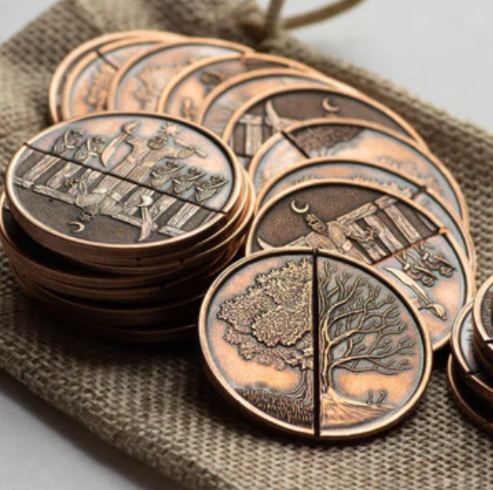
King Feyda Coin – World Builder
If it was not already hard enough to guess if what was behind the Doors of Stone was Iax, the name of the Moon or shaped creatures, there are a lot of reasons to think the immortal King Feyda is buried and held behind them.
This theory came to light when Patrick Rothfuss released a coin for sale on his website WorldBuilder, depicting King Feyda.
On one side is a full living tree and half a dead tree that could represent life and death, but also the Adem Sword Tree and the Cthaeh. On the other side, the first half depicts Feyda with a sun above his head and he is holding a slightly curved sword with a protective handle like the one Kvothe inherited from the Adem, and a map while five soldiers stand behind him. The other half shows him with a crescent Moon above his head, which looks like a skull, and the five soldiers are replaced by a waystone. He holds the same sword up, but the other hand is holding a branch of hemlock.
Hemlock is known to be poisonous, leading to death through respiratory failure. Funnily enough, hemlock symbolizes deception and betrayal due to its innocent-looking nature, but some say it symbolizes the calm acceptance of death. In modern witchcraft, hemlock is used for necromancy or underworld work.
King Feyda Calenthis became King post-mortem but it’s hard to find information regarding his timeline. If details lead us to think he was alive by the time of the Aturan Empire, I suspect he was alive during the Creation War. According to the Kingkiller fandom, House Calanthis ruled Vint since its founding. After the Aturan Empire came to Vint and established the Tehlin religion, the Calanthis took the throne of Vint from the Alveron family. The Lackless and the Jakis are also influential families in Vint.
The wizard-draugh King Feyda was King in life and King in death. A draugh is a creature that does not die and comes back to life.
Td941 on the Kingkiller Chronicle subreddit writes about his findings on the origin of the word draugh. The word draugh comes from the Norse saga of Eyrbyggja which follows two families whose relationships sour from friendship to warfare (Lackless, Calanthis, Alveron?). The main character in that saga creates chaos through war and rises again despite being buried, reburied and burned, until a high stone wall was constructed around his grave.
It’s fair to assume Feyda was set behind the Doors of Stone, which are made of copper (the same material as the coin) so he would not escape death again.
Was King Feyda a hero or a villain?
Some details led me to think King Feyda was on the right side of history. We know that out of the 8 cities, one was not destroyed after one of the protectors did not forget the Lethani. King Feyda carrying a branch of hemlock could represent deceit and betrayal. He might have been betrayed into immortality by Lanre or the Cthaeh, but when he realized it, decided not to destroy that one city. He might have accepted death and locked himself behind the Doors. This argument is supported by the sword King Feyda has on the coin, with a large handguard similar to the one given to Kvothe by the Adem. Vashet is hesitant to give that sword to Kvothe, meaning it has a significant history; it’s not any sword. When she gives it to him, she muses to Shehyn that ‘it will perhaps offset his name’. The name given by Magwyn to Kvothe was Maedre, which had angered Vashet as it meant flame, thunder and broken tree, a bad omen for the Adem, meaning that the sword might have belonged to someone with a better reputation in the Adem history. I wondered if it was the sword of King Feyda, although it was not mentioned anywhere in the sword’s Atas. We learned that the sword existed before the Blac of Drossen Tor and was owned by Finol during that battle, who had a lover called Dulcen. Two names we’ve never heard before.
On the other hand, King Feyda is inspired from the Norse story of a man who refused to die and sowed chaos. Kvothe is also said to rescue Auri from that King.
Devi
Devi is an intriguing character and although she’s not frequently involved with the plot, she may have a bigger part to play in the story. Kvothe being more powerful than the average student is an exception, and we seldom hear about students who could match him. Yet, Devi’s alar could match that of a master, and she is more powerful than Kvothe. She was expelled from the University for being a threat and is hungry for forbidden knowledge and access to the Archives. If Kvothe is a legend, what does Devi’s powers say about her?
Devi’s intentions are not clear and it’s hard to put her in the good or future-villain category. Because she’s unusually powerful, hunting for forbidden knowledge and wants access to the Archives, she could be connected to the Chandrian, either by searching for them or being part of them. In Kingkiller Chronicles, names are important and Devi sounds like Devil, her nickname is also Demon Devi.
Devi’s alar is described as the “ocean in a storm”, which is one of the three things all wise men fear. In my opinion, she definitely has her own agenda, which should end up being more or less connected to Kvothe’s.
Conclusive remarks
Here’s what I believe in after my research:
- Selitos is the one who forgot the Lethani.
- The one who did not betray a city is King Feyda, and I think the city was Tinusa, the current Tinuë. Kvothe owns his former sword.
- The Edemah Ruh, the Adem and the Sithe shares the same ancestors. The reasons the Adem know about the Chandrian and the Edemah Ruh do not is because any Edemah Ruh who sang about it were killed.
- The Chandrian were tricked into becoming immortal.
- The Cthaeh is linked to Ademre and the Lethani.
- The Sithe let Kvothe talk to the Cthaeh on purpose.
- The king Kvothe killed was King Roderic Calenthis and the new Penitent King is the Maer.
- Denna is not an Angel because she would know her patron is a Chandrian, and she would be more informed about blood magic. But I believe that she is supposed to mirror Kvothe and might be more powerful than we think.
Grey areas:
- Why does Lanre believe Lyra’s death to be on his hands?
- Who is the woman in Nina’s painting?
- Who does Perial represent in the tale?
- Does Encanis represent Haliax, Selitos or the Cthaeh?
- Is Kvothe the biological son of his parents?
- What caused Denna to run away from her home? What caused her lung disease and nightmares?
- Why is Puppet allowed to live in the Tombs?
I started this extensive analysis with the goal of compiling every personal and external theory I could come across, an impossible task considering the amount of content online. Some readers have studied the history of the Four Corners, language, politics, and etymology in a way that goes beyond my ability to cover it.
I was not able to put all the pieces of the puzzle together, but this analysis covers the main discoveries.
No fantasy saga has stimulated me the way the Kingkiller Chronicle has. The third book not having been released might have been a blessing in disguise, forcing me to reread the two books, analyse them, and research the story. Is there another fantasy saga that has united readers online to analyse a plot so intensively? The Kingkiller Chronicle is, in many people’s opinion, the most intriguing and stimulating world ever built.


Leave a comment